
Student Loan Budgeting: A Survival Guide for the Real World
Why Budgeting for Student Loans Feels Impossible — And How to Fix It
Budgeting for student loans is one of the most common financial challenges facing young adults in 2026 — and it doesn’t have to stay that way.
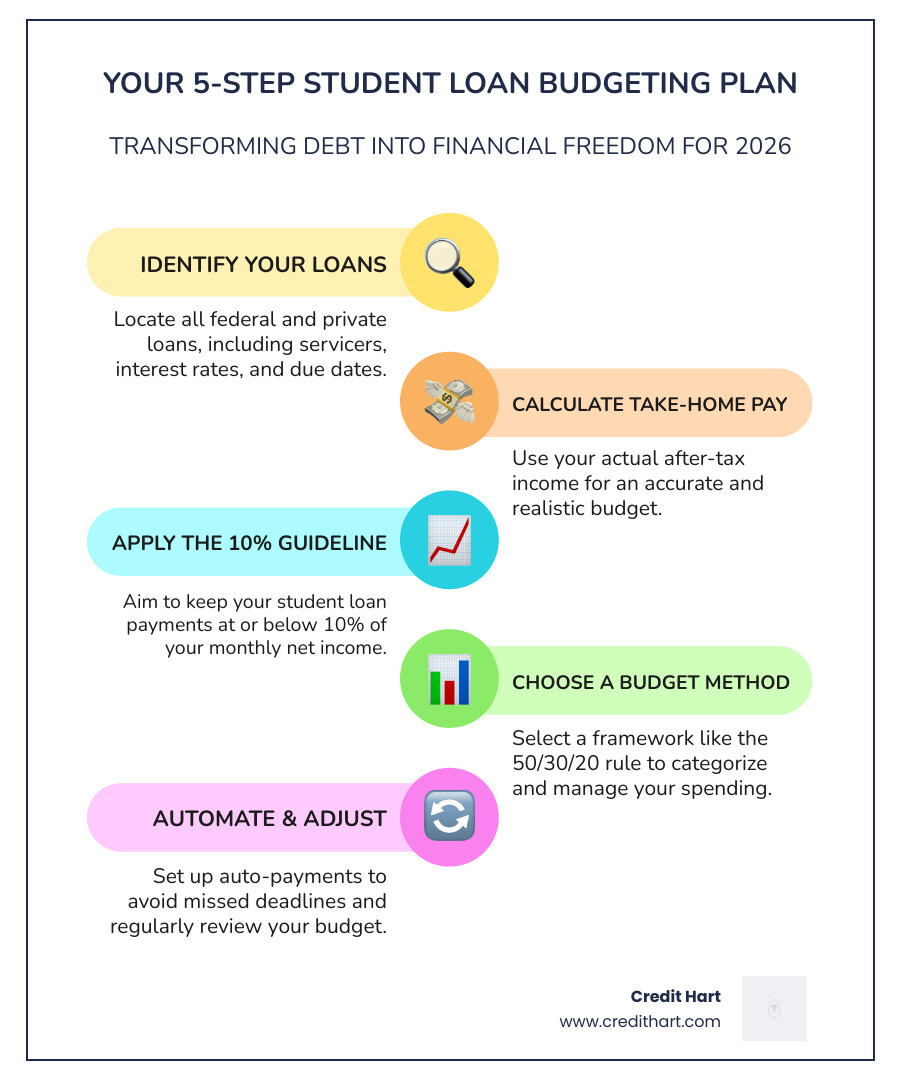
Here’s a quick snapshot of what you need to do:
- Find your loans — Check StudentAid.gov for federal loans and your credit report for private ones
- Know your numbers — Total balance, interest rate, monthly payment, and due date for each loan
- Calculate your take-home pay — Use your actual after-tax income, not your salary
- Apply the 10% guideline — Try to keep student loan payments at or below 10% of your monthly take-home pay
- Pick a budget method — The 50/30/20 rule is a solid starting point (more on that below)
- Automate and adjust — Set up auto-pay, then revisit your budget every month
If you’ve recently graduated — or if payments just showed back up on your statement after a long pause — you’re probably feeling the squeeze. You’re juggling rent, groceries, maybe a car payment, and now a student loan bill that averages around $500 a month for many borrowers.
That’s a real number. And for someone just starting out, it can feel like a punch to the gut.
The good news? A budget built around your actual life — not some perfect spreadsheet fantasy — can make these payments manageable. You don’t need to sacrifice everything fun. You just need a plan.
This guide walks you through exactly how to build that plan, step by step.
Mapping Your Debt: Finding Servicers and Terms
Before we can build a budget, we have to face the music. We can’t manage what we can’t see. Many of us have loans scattered across different platforms, and it’s easy to lose track of who we actually owe.
Where to Look
For federal loans, your home base is the National Student Loan Data System (NSLDS), accessible via StudentAid.gov. This dashboard is the “source of truth” for all federal borrowing. For private loans, your best bet is to head over to annualcreditreport.com. Since private lenders don’t report to the Department of Education, they will only show up on your credit report.
Identifying Your Servicers
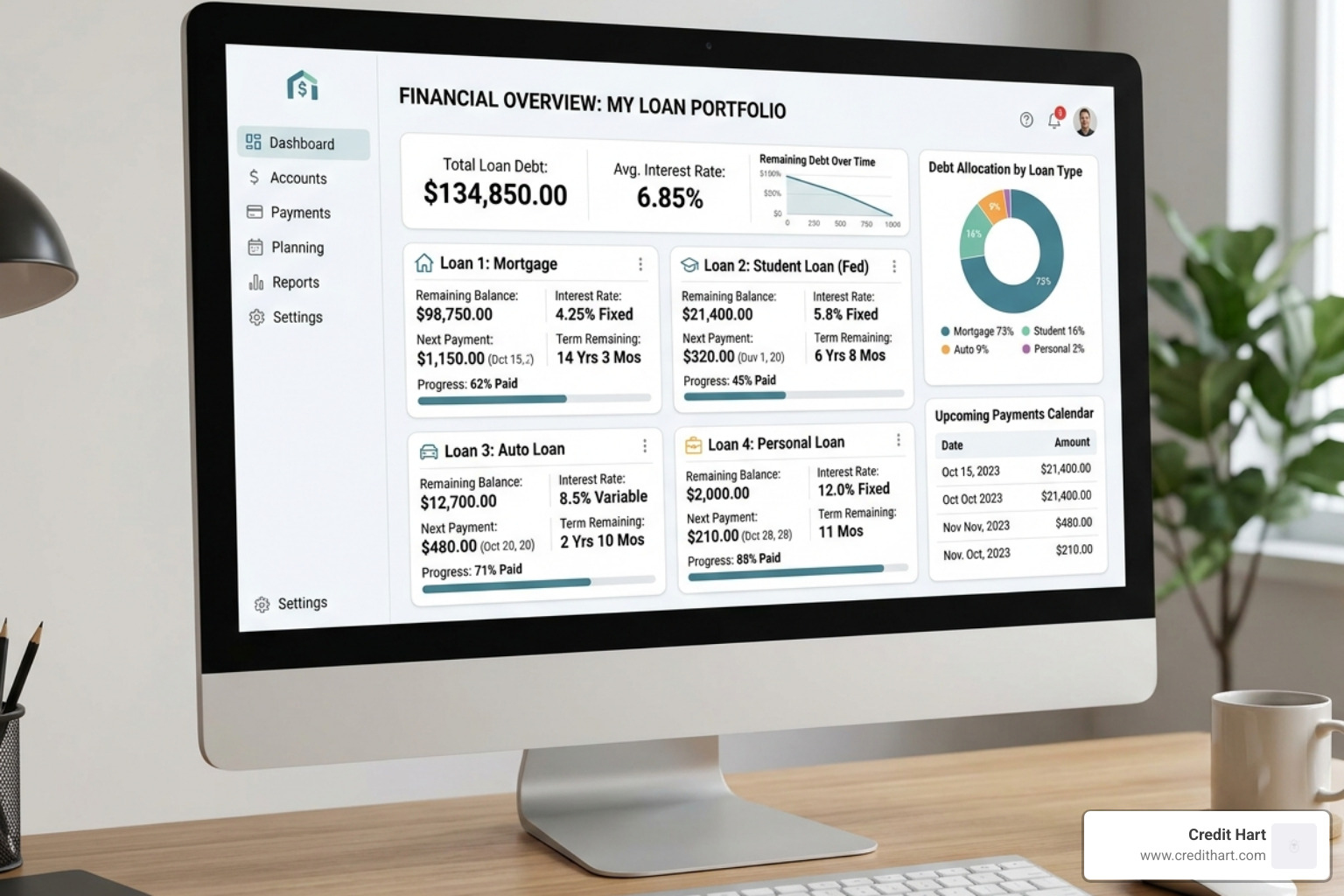
A loan servicer is the company that handles the billing. You might have borrowed from the government, but companies like Nelnet, Mohela, or Aidvantage are often the ones sending the “Please Pay Us” emails. Log in to your accounts to find:
- The Principal Balance: The actual amount you borrowed plus any capitalized interest.
- Interest Rates: Are they fixed or variable? Even a 1% difference can change your strategy.
- Due Dates: Missing a date by even 24 hours can hurt your credit score.
- Grace Periods: Most loans offer a six-month window after graduation before the first bill arrives. Use this time to save, not just spend!
Understanding these terms is the first step in Understanding your student debt. Once you have a master list—either in a notebook or a spreadsheet—the mountain starts to look like a series of manageable hills.
The Core Framework: Budgeting for Student Loans Step-by-Step
Creating a budget isn’t about restriction; it’s about allocation. We like to think of it as giving every dollar a job so it doesn’t wander off and get spent on impulse buys.
Assessing Your Monthly Income and Expenses
The most common mistake in budgeting for student loans is using your “gross salary” (the big number on your offer letter). In the real world, we live on Net Income.
- Calculate Take-Home Pay: Look at your actual paychecks after taxes, 401(k) contributions, and health insurance. If you’re a freelancer, remember the self-employment tax rate is 15.3%—set that aside first.
- List Fixed Expenses: These are the “non-negotiables.” Rent, utilities, insurance, and your minimum student loan payments.
- Audit Variable Costs: Look at your last 30 days of bank statements. How much did you actually spend on oat milk lattes or streaming services?
- Identify Discretionary Income: This is what’s left after the bills are paid. This is the money you’ll use to build an emergency fund or make extra loan payments.
Determining Your Ideal Payment Percentage
How much is “too much” to pay toward debt?
- The 8% Rule: The Department of Education suggests keeping student debt payments around or below 8% of your total monthly income.
- The 10% Cap: Many experts, including those at the Institute of Student Loan Advisors, suggest capping payments at 10% of your discretionary income to avoid “debt burnout.”
- The Burden Threshold: If your payment exceeds 10% of your total income, it’s officially considered burdensome. If you’re in this boat, it’s time to look at More info about budgeting services to find a better balance.

Popular Methods for Managing Your Monthly Payments
There is no “perfect” way to budget, only the way that you will actually stick to. Here is how the most popular methods stack up:
| Method | Best For | The Breakdown |
|---|---|---|
| 50/30/20 Rule | Beginners | 50% Needs, 30% Wants, 20% Savings/Debt |
| Zero-Based | Detail-Oriented | Every single dollar is assigned a specific task |
| Pay Yourself First | Minimalists | Move savings and debt payments out immediately |
Applying the 50/30/20 Rule to Budgeting for Student Loans
This is the gold standard for a reason. It simplifies your life.
- 50% for Necessities: This includes your housing, groceries, and the minimum payment on your student loans.
- 30% for Wants: Dining out, hobbies, and Netflix.
- 20% for Savings and Debt Repayment: This is where you put money into your emergency fund (aim for $500–$1,000 initially) and make extra payments on your loans to kill the interest.
Using Zero-Based Budgeting for Student Loans
If you find yourself wondering where your money went at the end of the month, this is for you. With Zero-Based Budgeting, if you have $3,000 coming in, you must assign all $3,000 to categories until there is $0 left. This might include “Cash Stuffing” or the envelope system, where you put physical cash into envelopes for things like groceries. It provides incredible financial clarity but requires a weekly time commitment.
Advanced Strategies: Snowballs, Avalanches, and Refinancing
Once you have your basic budget under control, you can start playing offense. Paying just the minimum is a trap—it keeps you in debt longer and costs you thousands in interest.
The Debt Avalanche vs. The Debt Snowball
- The Debt Avalanche: You list your loans by interest rate and attack the highest rate first. This is the mathematically superior way to save money.
- The Debt Snowball: You pay off the smallest balance first. While you might pay a bit more in interest, the psychological win of seeing a loan disappear entirely can provide the motivation you need to keep going. Research on debt repayment psychology shows that these “small wins” are often more effective for long-term success.
When to Consider Student Loan Refinancing or Consolidation
In April 2026, interest rates may have shifted. Refinancing involves taking out a new loan with a private lender to pay off your old ones, ideally at a lower rate.
- Pros: Lower monthly payments, lower interest, and one single bill.
- Cons: If you refinance federal loans into private ones, you lose all federal protections, including IDR plans and forgiveness programs.
Consolidation is a federal-only process. It combines multiple federal loans into one Direct Consolidation Loan. It doesn’t usually lower your interest rate (it takes a weighted average), but it can make you eligible for certain forgiveness programs like PSLF.
Navigating Hardship: IDR, Forgiveness, and PSLF
Life happens. If you lose your job or your income drops, don’t just stop paying. Defaulting on a student loan can lead to wage garnishment and a trashed credit score.
Income-Driven Repayment (IDR)
IDR plans like the SAVE plan (or its 2026 equivalent) cap your monthly payment at a percentage of your discretionary income. For some, this payment can be as low as $0 per month while still counting as an “on-time” payment toward eventual forgiveness.
Public Service Loan Forgiveness (PSLF)
If you work for a government agency or a 501(c)(3) nonprofit, you might be eligible for PSLF. After 120 qualifying payments (10 years), your remaining balance is forgiven tax-free. If you are on this track, your goal is to pay the absolute minimum allowed to maximize the amount forgiven.
The Fresh Start Program
If you are already in default, look into the Fresh Start program. It’s a one-time opportunity to bring defaulted loans back into good standing, stopping collections and restoring your eligibility for federal aid.
Frequently Asked Questions about Student Loan Budgeting
How do I find out who my student loan servicer is?
Log in to your account at StudentAid.gov. Under the “My Aid” section, you will see a list of your loans and the specific servicer assigned to each one. For private loans, check your credit report at annualcreditreport.com.
What percentage of my income should go to student loans?
Ideally, keep it under 10% of your take-home pay. If you follow the 50/30/20 rule, your debt and savings combined should make up 20% of your budget.
Can I change my student loan payment amount if I can’t afford it?
Yes. For federal loans, you can apply for an IDR plan or request deferment or forbearance. For private loans, you must contact your lender directly; many offer temporary hardship programs, though they are less flexible than federal options.
Conclusion
Budgeting for student loans doesn’t have to be a life sentence of ramen noodles and “no” to every social invitation. By mapping your debt, choosing a method like the 50/30/20 rule, and staying aware of federal protections, you can take control of your financial future.
At Credit Hart, we believe in stress-free rewards optimization. That means managing your debt efficiently so you have the freedom to enjoy your life today while building a secure tomorrow. Don’t wait for a “better time” to start. The best time to build your budget was yesterday; the second-best time is right now.
Start your student loan budget today and turn that mountain of debt into a stepping stone toward your goals.
