
Mastering Your Money While Mastering Your Degree
Why Good Budgeting Advice for Students Can Change Everything
The best budgeting advice for students comes down to a few core habits — here’s a quick overview before we dive deeper:
Quick-start student budgeting tips:
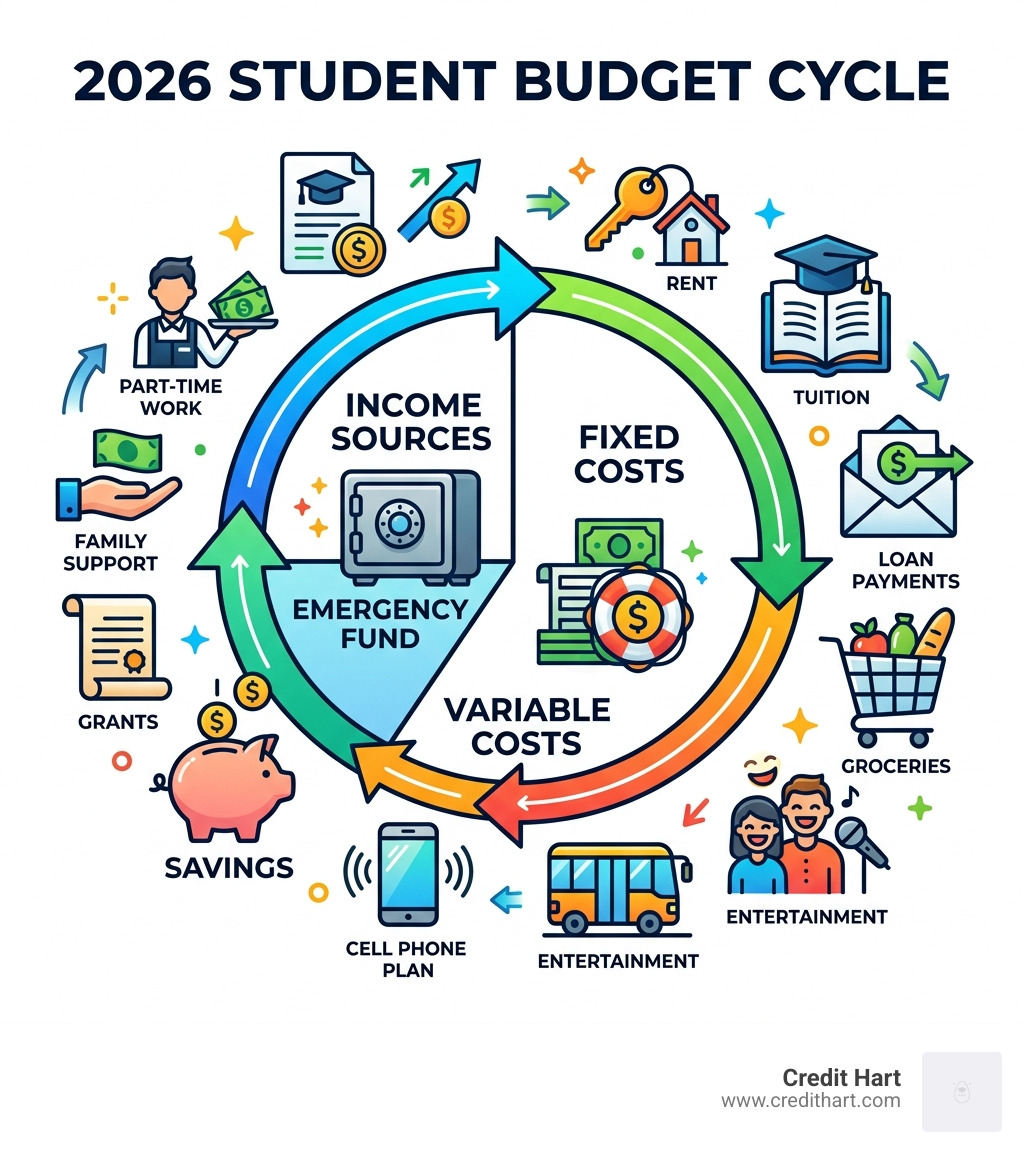
- Know your total monthly income — include financial aid, part-time work, family support, and grants
- Split costs into fixed and variable — rent and tuition vs. food and entertainment
- Use the 50/30/20 rule — 50% needs, 30% wants, 20% savings or debt repayment
- Track every dollar — use a free app or spreadsheet, check it weekly
- Build a small emergency fund first — even $500 makes a real difference
- Audit your subscriptions — most students waste $100+ per month on services they barely use
- Avoid treating loans as income — borrowed money has to be repaid, with interest
Money stress is real — and it hits students harder than most people realize.
Financial stress is actually the number one reason students drop out of college, ahead of failing grades or personal problems. Not falling behind in class. Not homesickness. Money.
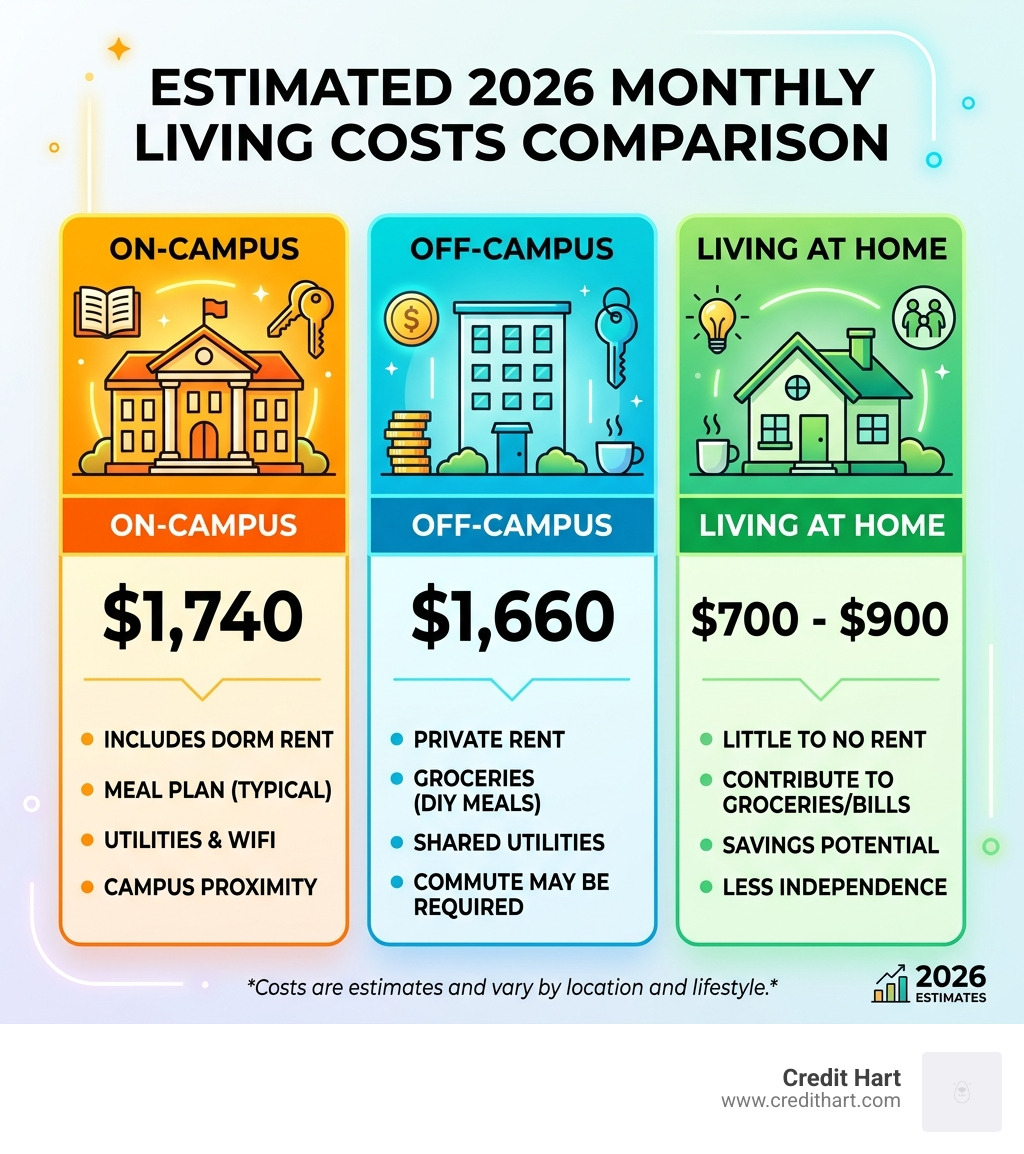
And it’s not hard to see why. Students in 2026 are navigating average federal loan balances of around $39,100, monthly living costs of $1,660–$1,740 (not counting tuition), and a constant pressure to keep up socially while keeping costs down.
The gap between what’s coming in and what’s going out can grow fast — especially when income arrives as a lump sum and feels like more than it actually is.
Here’s the thing: budgeting doesn’t have to mean deprivation. It means knowing where your money goes so you can make deliberate choices about it. Students who build this habit early don’t just survive college with less stress — they graduate with a real financial foundation.
This guide walks you through everything, step by step.
Why Budgeting Advice for Students Is Essential in 2026

As we navigate the economic landscape of April 2026, the stakes for student financial literacy have never been higher. We often hear that college is a “trial run” for adulthood, but the financial consequences are very real. When we look at the data, the average federal student loan balance has climbed to approximately $39,100. This isn’t just a number on a screen; it’s a weight that many graduates carry for decades.
Scientific research consistently shows a powerful link between financial literacy and student retention. Students who understand how to manage their cash flow are significantly less likely to drop out. Why? Because they aren’t blindsided by a $500 car repair or an unexpected textbook fee. They have a plan.
Furthermore, the habits we build now form our credit score foundation. A single missed credit card payment or an ignored utility bill in your sophomore year can lower your score, making it harder to rent an apartment or get a car loan after graduation. By following sound budgeting advice for students, you aren’t just surviving the semester; you are preparing for post-grad life where “budgeting” becomes “wealth building.”
Calculating Your Monthly Student Cash Flow

One of the biggest hurdles we face is the “lump-sum illusion.” This happens when your maintenance loan or financial aid refund hits your bank account at the start of the term. Seeing $4,000 in your balance makes you feel incredibly wealthy. However, if that money has to last 12 to 15 weeks, it disappears much faster than you think.
To combat this, we recommend dividing your total semester income by the number of weeks in the term. This gives you a “weekly allowance” that is much more realistic than looking at a large, temporary balance.
When calculating your cash flow, it is vital to distinguish between repayable income (loans and lines of credit) and non-repayable income (grants, scholarships, and job earnings). Every dollar of repayable income you spend today will cost you significantly more in the future. For example, a $5,000 loan at 5% interest can easily cost over $7,000 to repay over a decade.
Identifying Your Income Streams
To get an accurate picture, we need to list every single source of money:
- Scholarships and Grants: This is the best kind of money because you don’t have to pay it back.
- Federal Work-Study: These jobs are often more flexible with your exam schedule.
- Family Contributions: Whether it’s a monthly allowance or a one-off gift.
- Part-time Jobs and Side Hustles: Earnings from retail, tutoring, or freelance work.
- Savings: Money you earned over the summer that needs to be stretched.
Consistent income (like a steady job) is easier to budget than irregular income (like birthday money or freelance gigs). We suggest budgeting based on your guaranteed minimum income and treating the irregular “extras” as bonus savings.
Essential Budgeting Advice for Students: Fixed vs. Variable Costs
Once we know what’s coming in, we have to look at what’s going out. We categorize these into “Fixed” and “Variable” costs.
Fixed Costs (Non-negotiable):
- Tuition and Fees: Usually paid once a semester.
- Rent/Dorm Costs: Your biggest monthly expense.
- Utilities: Phone bill, internet, and electricity.
- Insurance: Car or health insurance premiums.
Variable Costs (The “Flex” Zone):
- Groceries and Dining Out: This is where most budgets fail.
- Entertainment: Concerts, movies, and nights out.
- Transportation: Gas, Uber rides, or public transit.
- Personal Care: Clothing, toiletries, and haircuts.
Beware of “silent consumption.” This refers to the $400–$600 per month that disappears into small, untracked purchases like daily lattes, $15 Uber rides, and $12 lunches. Over a semester, this “leak” can total thousands of dollars.
Proven Budgeting Frameworks for College Life
We don’t believe in one-size-fits-all solutions, but having a framework makes the process much easier. Here are the most effective methods for students:
1. The 50/30/20 Rule (The Gold Standard) This is the most popular method for a reason. You allocate:
- 50% to Needs: Rent, groceries, basic utilities, and minimum debt payments.
- 30% to Wants: Dining out, hobbies, and Netflix.
- 20% to Savings and Debt Repayment: Building your emergency fund or paying down high-interest credit cards.
2. Zero-Based Budgeting Every single dollar is assigned a “job” before the month begins. If you have $1,200 coming in, your categories (Rent + Food + Fun + Savings) must equal exactly $1,200. This prevents money from “leaking” out of your account.
3. Pay Yourself First The moment you get paid, you move a set amount (even just $25) into a savings account. You then budget whatever is left. This ensures that savings aren’t just an afterthought.
4. The Envelope System For those who struggle with overspending on “wants,” this involves withdrawing cash for categories like “Eating Out” and putting it in an envelope. Once the cash is gone, you stop spending in that category until next month. Digital versions of this exist using banking “pots.”
Implementing Budgeting Advice for Students with Apps and Tools
In 2026, we have incredible technology at our fingertips. Many modern banks offer “pots” or “spaces” that let you visually separate your rent money from your fun money within the same account.
We recommend using digital spending trackers that link to your accounts. These apps provide real-time balance alerts, so you know exactly how much is left in your “Groceries” pot before you hit the checkout line. If you prefer a more hands-on approach, a simple spreadsheet template can be just as effective for tracking your monthly progress.
Strategic Ways to Cut Costs and Build Savings
Cutting costs doesn’t mean you have to sit in a dark room eating unseasoned rice. It’s about being strategic.
- Textbook Hacks: Never buy new. Use sites like Chegg or Amazon to rent, or check the library for Open Educational Resources (OER). This can save you $500–$1,000 a year.
- Student Discounts: Platforms like UNiDAYS and Student Beans are essential. Always ask, “Do you have a student discount?” before paying.
- The Subscription Audit: We’ve found that the average student spends $100+ per month on subscriptions they barely use. Cancel anything you haven’t used in the last 30 days.
- Bulk Buying and Meal Prepping: Spending $50 on a Sunday grocery haul can replace $150 worth of mid-week takeout.
- Energy Conservation: In shared housing, being mindful of heating and lights can save your group $20–$50 a month on utilities.
Research shows that reducing student debt by even a few thousand dollars can have a massive impact on long-term wealth. The less you borrow now, the more of your future paycheck you get to keep.
Balancing Part-Time Work and Academics
Should you work while in school? Usually, yes — but with limits. Research consistently shows that working 10–15 hours per week is the “sweet spot.” Students who work within this range often have higher GPAs than those who don’t work at all, likely due to better time management.
However, once you cross the 20-hour-per-week mark, GPA typically drops by 0.2 to 0.4 points. Your degree is your primary investment; don’t let a part-time job jeopardize your graduation.
Consider flexible side hustles:
- Tutoring: High hourly pay and reinforces your own knowledge.
- Freelance Design/Writing: Build a portfolio while earning.
- Campus Jobs: Often include “down time” where you can study while getting paid.
Frequently Asked Questions about Student Budgeting
How much money does the average student need per month in 2026?
Beyond tuition, the average student needs between $1,200 and $2,500 per month depending on location. On-campus living averages around $1,740, while off-campus shared housing sits at roughly $1,660. If you are living at home, your costs drop significantly to $700–$900.
What is the best way to handle a financial aid refund check?
Treat it like a salary, not a jackpot. Immediately move the portion meant for future months into a separate savings account. Only “pay” yourself the weekly amount you calculated during your cash flow analysis.
How do I build an emergency fund on a limited student income?
Start small. We recommend a “starter” fund of $500. This covers most common student emergencies like a broken laptop or a flat tire. Automate a transfer of just $10 or $20 a week. You won’t miss the money, but you’ll certainly appreciate the peace of mind when something goes wrong.
Conclusion
Mastering your money while mastering your degree is one of the most valuable skills you will ever learn. At Credit Hart, we know that financial wellness isn’t about being perfect; it’s about being proactive. By following this budgeting advice for students, you are reducing your stress today and optimizing your rewards for tomorrow.
Don’t wait until you’re facing a “cash flow crisis” to start. Pick one framework, audit your subscriptions this weekend, and start building that emergency fund. Your future self will thank you for the long-term stability you’re creating right now.
